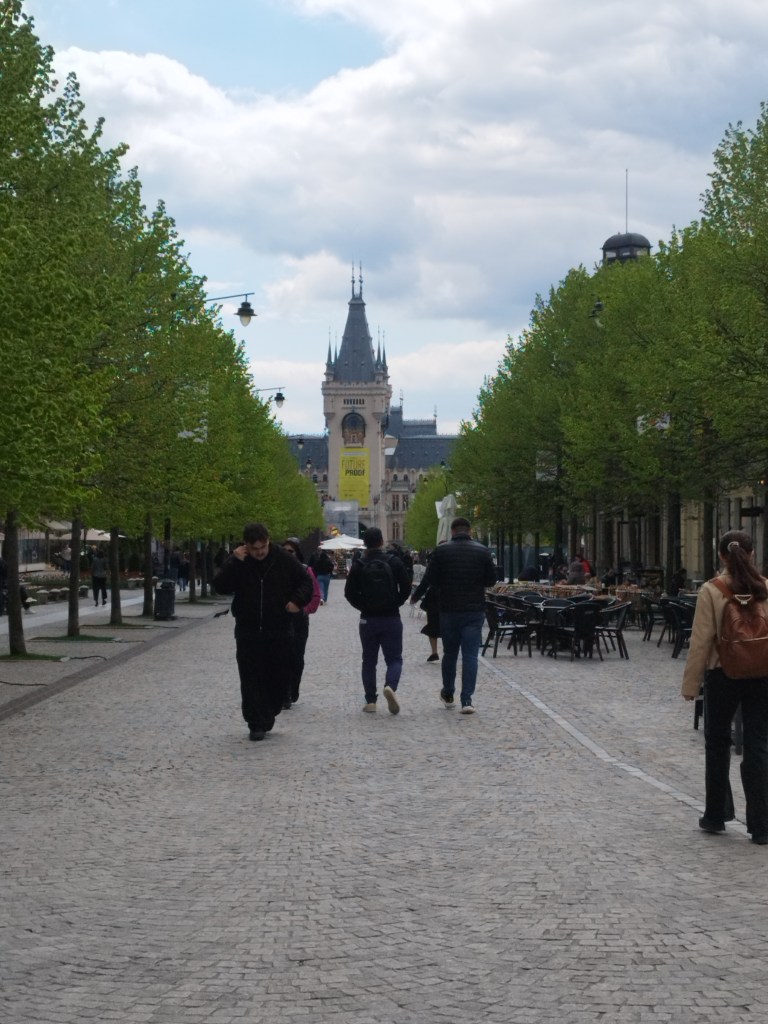
Not only was the journey to Iași undertaken in blissful solitude, it was also enjoyed from the best seat in the house. Or aeroplane, in this case. The presence of enough luggage to see me through three weeks of uncertain Spring weather necessitated a more comprehensive ticket than I would usually get, including therein the exhilarating option to choose my seat with no added fee.
Of course it had to be 1A. Well, wouldn’t you?
Oh my. Leg room, toilet proximity, space to get to toilet and back without waking the neighbours, dinky little table tucked into the seat arm, lack of inconsiderate traveller reclining backwards into my lap, my hand luggage stored in a special locker, first dibs on the drinks’n snax trolley, first passenger off the plane at the other end…
All for less than 250€ return as I did NOT have to travel during the SCHOOL HOLIDAYS for the simple reason (and I may not have mentioned this) that I was travelling ON MY OWN! Sans famille. Sans enfant. Even sans mari. Oh my, indeed.
The arrival in Iași was mildly complicated by the glaring absence of my ride transfer. Had I not been lugging a 30kg suitcase, a 10kg backpack, a bulging tote bag, a handbag, almost 50 years in age and an excess of corporeal kilos, I would have taken the bus. But I was, so I didn’t. Instead I complacently patted myself on the back for having had the foresight to book a transfer through Wizz Air, or Booking.com – one of them, anyway. Ha.
I exited Sosiri already cringing with embarrassment at the prospect of a driver leaping forward with my name on a bit of card, but I could have saved my blushes because none of the bodies hovering outside the sliding doors seemed remotely interested in me. Admittedly we had landed earlier than expected, so I hung around for 20 minutes before ringing to query the situation.
The ride share company declared no knowledge of me whatsoever. The confirmation email sent from their company email address must have been the work of elves, because they had no booking under my name in their system. They had no booking for Iași at all, and could not (for reasons unspecified) arrange another one. Very sorry and all that, you will just have to request a refund.
This was not my first experience of my host country, so I was more inconvenienced than shocked. Thankfully, I had also taken the advice to open an online Revolut bank account with virtual card (Revolut is VERY popular in Romania), so by simply downloading the Uber app, I assumed it would be the work of a moment to order and pay for alternative transportation.
App duly downloaded I requested a car, and Uber looked for a car. In fact it looked, and it looked, and it looked. As the minutes ticked past without a car being found, I decided to use the wait to continue setting up my account, which I soon discovered had no desire to sync (or whatever the word is) with my Google Wallet, or my virtual Revolut card or my UK bank card. Although I could not be entirely sure it was a synching (or whatever the word is) problem – it might just have been that the internet was so slow that everything kept timing out.
Cash could have been an option: I had sterling ready to change once the schimb valutar opened on Monday, and Romanians are often happy to accept other currencies as payment, but the journey would cost around 8Lei (£1.30) and the smallest note I had in sterling was £20.
I thought wistfully back to the moment my husband had urged me to take some Lei with me in cash just in case, remembering the confidence with which I had chuckled ‘no need, Amore – I have everything I could possibly need on my phone‘.
Oh well, perhaps there would be some custard to go with my humble pie.
Luckily I had one avenue left to try – endlessly patient Romanian teacher, Magda. I rang her (very apologetically, it was Sunday after all) to ask her advice, at which point she promptly ordered and paid for an Uber from her own app.
It was all systems go once again – sizeable dent to my Modern-Day Nomad ego and/or credentials notwithstanding.
The Uber driver, after an initial grumble at the heft of my suitcase, proved to be very personable. He wasted no time in asking where I was from, and then proceeded to dazzle me with his spoken English. But while I did not mind humouring him on this occasion (I was just relieved to be leaving the airport), it was a situation I had secretly been dreading. Three weeks of intensive Romanian immersion could easily become a pipedream if everybody insisted on speaking to me in English.
Romanians have a higher propensity for language acquisition than the natives of my “other” countries, for a number of reasons:
Romania, like the Scandinavian countries and the Netherlands among others, does not dub foreign films or television content; instead providing subtitles. This constant exposure to (primarily) English from teenage viewing upwards permits those with a natural linguistic bent to attain near fluency without even leaving their country. Such was the case of my driver who, despite never having visited an English-speaking country, boasted a level of English that put my Romanian to shame.
(English is not the only language that sneaks in via the visual media – Latin American telenovelas have also done their bit to build widespread Spanish competence as well.)
But the multilingualism of many Romanians is not just down to too much television, it is also down to necessity. Romanians have long migrated all over Europe and beyond in the search for work. A generation ago it was primarily the men: famed for their work ethic and their skill in many of the different building-related trades, theirs was, and still is, a sought-after workforce. Men from my husband’s village, for example, are known to be excellent carpenters: his father spending most of his adult life working away in Israel, as well as in other Middle Eastern countries. My brothers-in-law have worked closer to home in Germany, Switzerland, Hungary, France, Italy…
It is not an easy life: the men often living in cheek-by-jowl groups, only returning home a couple of times a year. It is hardly surprising that cigarettes and alcohol frequently become a staple in an existence otherwise lacking in comforts.
The men worked away and the women stayed at home to bring up the children, take care of the smallholding, with many working outside the home as well. Romanian women are without doubt the most resilient, hardworking and hardy people I have ever met.
In later years, women starting going abroad to find work, leaving the children with grandparents or other relatives. They also had to head to where the work was, so often nowhere near their husbands. The husband might be working on a building site in Germany, while the wife worked as a cleaner or a carer in Italy.
Thankfully today Romanian families are far more likely to emigrate together, giving rise to a new generation of Italians, Spanish, French, German, British youngsters with Romanian origins. Western Europe should be grateful for the injection of such hardy DNA into their gene pool.
Anyway, suffice to say that it is rare to find a working-age Romanian who does not have a reasonable grasp of at least one other language.
Having covered topics as wide-ranging as the evils of AI (IA inteligența artificială) to the pointlessness of politicians, and after a small amount of dithering when neither of us could spot the street number we were looking for, my luggage and I were deposited on the pavement of Strada Cuza Vodă to fend for ourselves.
Welcome to Iași.


Leave a Reply