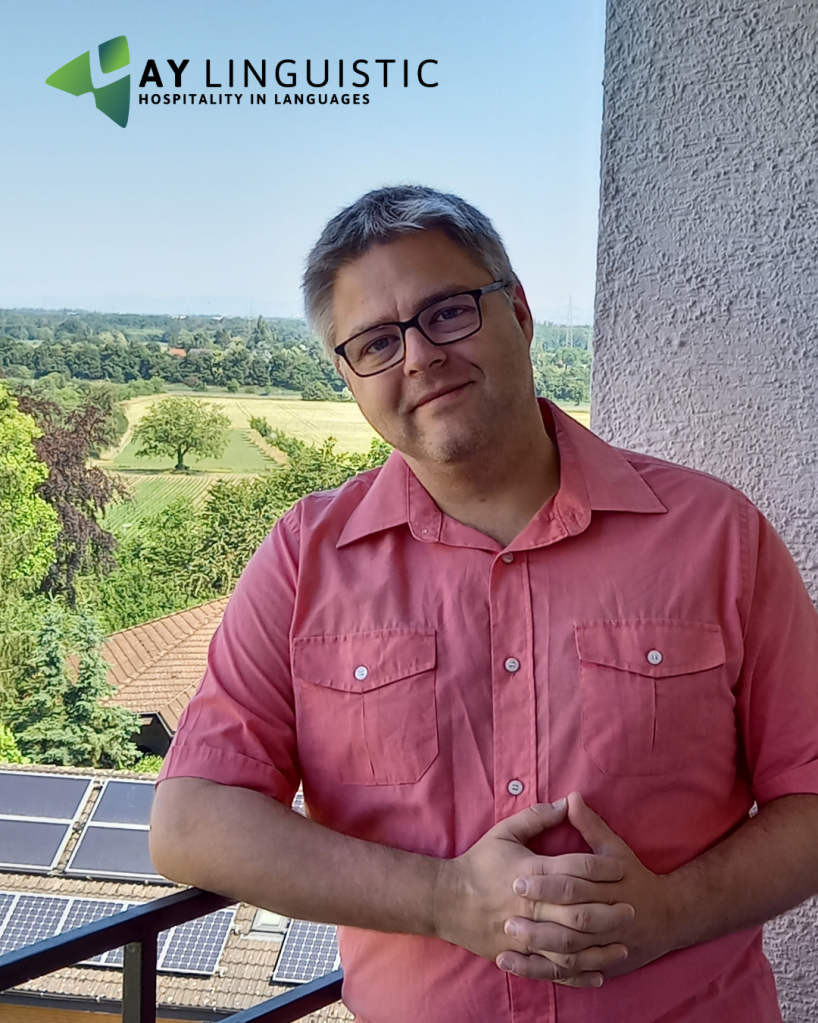
Adam Yeomans, translator
German, French & Italian into English translations
Tourism & Hospitality Marketing, Websites, Brochures translation
AY LINGUISTIC hospitality in languages
This week MTTM meets Adam Yeomans, a UK English native speaker, and translator of German, French and Italian into English. Adam has been a resident of Ettlingen, Baden-Württemberg, Germany, since June 2017, and is passionate about helping hospitality businesses communicate with the world.
What are your source and target languages, and how did you learn your source languages?
In order of proficiency, I speak German, French and Italian and translate these languages into English. German was my first foreign language at school at age 11, then I started French at 12 and Italian at 16. I did a triple major BA (Hons) in these three languages, which involved semesters abroad in Florence, Lyon and Vienna. Then, after I had finished my first degree I did an MA in European Studies, a two-year British Council language assistantship working at schools in Germany – in Karlsruhe and Ettlingen (where I live now, incidentally!), to be precise – and a PGCE in Secondary MFL before becoming a secondary school teacher at a school in England.
When did you first consider becoming a translator, and why?
It’s a sad story with a happy ending … in 2011, I had to be invalided out of my first teaching post halfway through the school year due to ill health. In the UK, leaving a teaching post before the school holidays begin, whatever the reason, is a red flag – you’re deemed unreliable if you do, as it leaves the school in the lurch, scrambling to find and pay a supply teacher to cover your classes while they recruit your replacement. I was unemployed and on the sick, applying for work left, right and centre. I even volunteered at my former secondary school, teaching 12 lessons per week, just to keep my hand in and with the misguided understanding that this would make my applications more appealing to schools. It didn’t. I must have applied for 30 jobs, was invited to four interviews, didn’t get any of them. They didn’t care about my volunteering experience at all. Eventually, in 2013 an old uni friend suggested I give translation a shot, so I thought “why not?” and haven’t looked back since.
Did you undertake formal training to become a translator, and if so, what?
On my friend’s advice, I started the online MA in Translation at Bristol University in the UK in September 2013, and I passed with distinction.
The course included modules in Translation Theory, Applied Translation (sectors where you can be more creative with language, like journalism, advertising, marketing etc), Introduction to Specialised Translation (sectors like legal, scientific, technical, medical, where there isn’t this wiggle room), the state of the industry (at the time, 2013/14) and CAT Tools.
What are your specialisms, and how did you choose them?
During the course, I shone better in Applied Translation, so I was naturally drawn more towards creative texts. About six months in to my career, someone passed my name to a colleague who needed to outsource a tourism text – it was for a hotel and ski resort in South Tyrol – and I was hooked. I selected tourism as one of my specialities straight away. As my career progressed, I took on texts from a range of other sectors, trying to identify another niche, and this reiterated that I like working with creative language, so marketing and advertising, product descriptions etc were another natural choice for me. More recently, I’ve enjoyed working with journalistic texts and regularly translate a huge proportion of a magazine for the maritime logistics sector. Plus, in the past few years, one of my agency clients has entrusted me with translations in the PV energy/sustainability sector, which, I was surprised to learn, I really enjoy and am quite good at …
How did you launch your translation career?
Funnily enough, one of my course mates on the MA gave me my first paid job. She already had an established freelance business, but wanted an academic qualification to make herself more attractive to new clients. On 2 December 2014 she outsourced a text to me, thus giving birth to my own business AY Linguistic. The usual client acquisition measures followed.
Since qualifying as a translator, have you undertaken further studies to hone your specialisms and/or languages?
I’m not really sure if this counts, but in 2022 I was temporarily employed, in-house, but remote, by an Austrian marketing agency as their “marketing transcreation specialist” alongside my freelance duties. Their clients were 4 and 5-star superior luxury hotels, as well as a few outdoor/adventure hotels and wellness resorts. This was right up my street, and I was able to learn a great deal more about translating marketing texts for the tourism and hospitality sectors than I thought I ever knew. I also received a little training in things like SEO and leveraging social media (Facebook, Instagram) for their clients, which has proven useful since I left them as well.
Which translation associations or groups are you a member of? Which are most helpful for offering support, and which (if any) are a good source of work leads?
I’ve been in the BDÜ (the professional association of qualified interpreters and translators in Germany) since just before covid hit, which was rotten luck as my hope was to increase my presence and client portfolio, only for the work to come to a screeching halt not a month and a half later. Since the world has returned to normal, being a member hasn’t led to any work yet, but I remain optimistic. Plus. I’ve enjoyed the social events being a member has allowed me to attend.
Which translation tools do you use the most?
The CAT tools module during the MA provided training in Trados and Wordfast Pro. I much prefer Trados out of the two. Since then, I’ve been learning MemoQ and have experience with XTM and Memsource. If I had to pick, MemoQ and Trados vie for the top spot on my favourites list.
How do you promote yourself and find clients?
I’m quite rubbish at self-promotion, if truth be told. As I’m a people person, most of my recent collaborations have come about due to chatting with people on LinkedIn and engaging with their content. A lot of my work before I started posting in LinkedIn came through word-of-mouth/Facebook and other translators would regularly outsource surplus jobs to me. That’s happened less and less since covid, though. I only have two outsourcer clients now, where before covid I had around ten.
Finding direct clients in my specialist fields has always proven hard. Even before covid and the advent of AI, the hotels, tourist boards and tourist attractions I’d approach would say they already use a trusted marketing or translation agency that they wouldn’t leave in favour of working with a one-man-band.
If you work with agencies, how do you make a good first impression, and do you send them professional updates to keep yourself relevant to them?
I’m a people person, as I said, so I like to reach out on LinkedIn or over the phone, have a wee chat to see if our standards and expectations align, then I’ll send my application and have them onboard me. While an assignment is ongoing, I prefer to pick up the phone to ask any questions rather than write an e-mail. It’s much more personal that way and, most of the time, the query or problem can be resolved immediately.
If I find myself in a bit of a gap, I might give the PMs at these agencies a call, just to say hi and check in with them. An e-mail can be ignored or forgotten, or be filtered into spam folders. A phone call happens in the here and now and you can gauge from the tone of their voices what the lie of the land is.
You do have to be aware, as I discovered, that your PM might not have the time to talk with you in that precise moment, and you might also find agencies that have an “e-mails only” policy.
Would you ever consider going in-house, or is the freelance life more for you?
As I mentioned, I did work in-house for a brief spell, only 8½ months, in 2022. I enjoyed the nature of the work, how steady it was and the guaranteed salary, but I missed the freedom of being able to nip to the supermarket or out for lunch, for example, whenever it suited me. Plus, the office dynamic (incl. e.g. gossiping/bullying, politics/favouritism, one-upmanship, unnecessary pressure, punishments if things don’t quite go as expected) can be quite cutthroat, even if you work remotely, and this is what did for me ultimately. I much prefer being my own boss. The only person I have to answer to is myself and I’m the direct link to the client – instead of the message potentially being diluted or embellished as it passes from CEO, to senior management, to department head, to team leader, to me, I can find out exactly what they want and get it done for them.
What does a normal working day look like for you?
Up at 7 or just before, a brisk 45-minute walk before having breakfast in front of the TV, then across to the computer for 8:30 at the latest. Break for lunch at 12-1 and I tend to finish for the day at 5 or 6 – when I was single, I used to work into the night, but now I’m living with my partner, I obviously have to consider her schedule as well. Three days a week, I have to leave during the afternoon to visit my private tuition students, so I have to take that into account, and I also have two clients taking the online “Speak English like a Brit” conversation course you might have seen me plugging on LinkedIn in the past, so sometimes I have to stop translating to teach them. It’s great for adding a little variety to the day.
What is the most satisfying translation project that you have worked on recently?
There have been a few. One of my direct clients is a Swiss-based company that puts together and promotes outdoor holidays (hiking, climbing, mountainbiking, cycling) and each time I complete a task for them, it’s an absolute joy. Last year, though, I was part of a team that worked on localising a computer game called “Drova – Forsaken Kin”. I translated roughly a third of the dialogue. As I used to be an avid gamer in my youth and still dabble from time to time if a new game takes my fancy, it was such a fun experience – I would do it again in a heartbeat!
How would you like your translation career to progress over the next 5 years?
I’m not greedy – as long as I’m earning enough to keep my partner and me housed, clothed, fed and watered, I’m happy! Having said that, I’d love to have a few more direct clients in the tourism and marketing sectors, and to have a few more trusted agencies on my books, to maintain a little variety in the types of assignment I work on, if nothing else. Having said that, though, my previous work with outsourcers and my current work with agencies has opened my eyes to other subject areas I didn’t know I was capable of working in, so I’d also have nothing against adding a few more strings to my bow in that regard.
What are your thoughts on the future of the translation industry since the advent of AI?
In my humble opinion, AI won’t be the ultimate death knell for the translation industry. What I feel it is doing, though, is sewing so many seeds of malcontent and mistrust at the moment that I can’t say confidently that this is the same profession I entered in 2014. The lay of the land has definitely changed.
What do you mean by that?
Well, I spoke with a colleague not long ago whose longest-standing and most prolific client openly stated recently that they’re dropping him in favour of their AI subscription and post-editing performed by their (German, not even an English native speaker) receptionist, who had spent a gap year in Canada when she was 19. He tried to talk them round, remind them of the excellent professional relationship they had, reiterating the value and profit he’s helped them achieve over the years, especially as he’s a native speaker with his ear to the ground re: linguistic and cultural developments, but they were having none of it. They unashamedly stated that money can be saved by getting rid of the qualified, experienced translator, whose very qualifications and experience justify him charging the prices he does, and having AI do it. The texts they’ve produced since ditching him are of a greatly reduced quality, but his attempts to show them this are falling on deaf ears. A six-year professional relationship up in smoke because “AI is new, so it has to be better”. He’s so incensed and resentful of this attitude that he’s thinking of leaving the profession altogether.
Another colleague told me the story of when one of her agency clients asked her to sign a new contract that included a clause agreeing not to use Generative AI in her work. She’s very anti-AI anyway and has never used it, not even for brainstorming, so she was glad to sign. The next job she did for them was instantly rejected and they refused to pay. Why? They’d run her work through one of these AI detectors and determined she’d used it on 80% of the text (she hadn’t). They said they recognised it was a “first offence” (the cheek!) and allowed her the opportunity to redo the work, warning her never to use AI again as doing so would constitute a breach of contract. So, she cynically added a few typos here and there and resubmitted without changing anything else … the work was accepted and praised as being excellent. The lack of trust apparent here beggars belief!
If things like this are happening, how do you think we can coexist with AI, then?
I personally see value in two distinct approaches:
1) translation without AI support – it’s still valid. It still works. We’re good at it and there are clients out there prepared to invest in it,
and
2) translation with AI support – but here I mean translations performed with AI used as a brainstorming or research tool and NOT as a means to translate the whole thing and post-edit it. Doing the latter will inevitably take longer, as you not only have to check the translation, you also have to fact check the entire text to weed out any “hallucinations”.
Just because something is new and on the cutting edge of technology doesn’t automatically mean that it’s better. Slowly but surely, though, I feel translation buyers are realising this and coming back to us, which leads me to believe the sector isn’t dying, as I said before, just the dynamics have changed considerably since I started in 2014.
Have you diversified, or do you plan to diversify, into another career?
I want to stay in translation as long as possible, but I’ve increasingly been offering private tuition in English and French to local school children to bridge the gap if I have a slow translation month. Last year, I also launched the “Speak English like a Brit” course I mentioned earlier, which is aimed at people who already speak English really well, but who’d like to practice things like pronunciation and learn typically British idioms. We talk, mainly, but if the student wants to watch a UK TV show and answer questions on it or if they’d like to do reading comprehensions on particular topics, we can do that too. I also wouldn’t be against returning to classroom teaching, but at a language school for adults, not in the state sector.
What are your Dos and Don’ts for new translators just starting out?
Do engage with other translation peers on LinkedIn and Social Media – it’s alright to ask for help or advice. But try to remain professional with them and …
Don’t come across like you’re begging people, especially colleagues you don’t know very well, to outsource work to you. They may not have seen your work before, you may not have built up a good-enough level of trust and simpatico with them for them to feel comfortable doing so and, let’s face it, in today’s climate they may not be able to afford to give their work away, anyway. I’m certain that this is why the number of colleagues willing to outsource to me has dropped as dramatically as it has since 2020.
Do remember the difference between proposing a collaboration and applying for a job. If you’re freelancing, you propose a collaboration; if you’re after an in-house role, you apply for a job.
Don’t be downhearted or disillusioned each time an agency doesn’t acknowledge your approach to work with them or a translation buyer rejects your collaboration attempt, and …
Do ask them for feedback on why they chose not to work with you and, if they give it, tweak your approach for the next potential client. Obviously, no two clients are the same, but there are always lessons to be learned.
Don’t assume that, just because you’re new to the profession, you’re not allowed to be paid the same as a 10+ year veteran. Added to this, try not to let agencies based abroad lowball your rate simply because translators living there can afford to charge less. For example, the cost of living is higher in Germany than in, say, Italy, and you ultimately have bills to pay, so you need a rate that reflects the cost of living where you live, not where the agency is based. Be confident in your pricing, know your worth and don’t let potential clients convince you that X cents per word is a “standard rate” for where they are or for someone of your experience.
Thank you so much for volunteering for MTTM, Adam. I have greatly enjoyed reading about your translation journey and experiences – your comments on AI are especially wise and on point. I look forward to the day businesses around the world realise that AI will never be a shortcut to obtaining quality translation. Translation is important enough to pay for, and the art of translation is, and will only ever be, uniquely human.


Leave a Reply