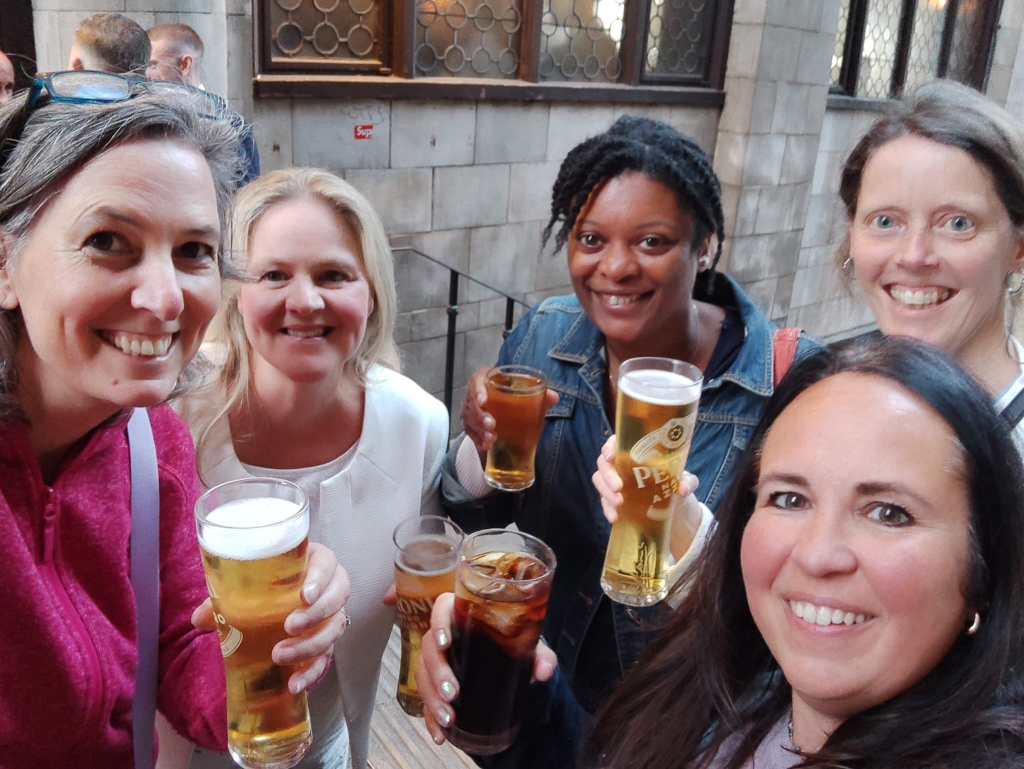
Astrid Melite (in the middle with her colleagues)
English and German to French Translator
Media and Finance Translation
This week’s “Meet the Translator Monday” is going to be slightly different, as we have decided to liven things up with a bilingual version: << Le lundi, c’est Meet the translator >> ! For this, Astrid has translated my questions into French and answered them in French, and I will be translating her answers into English.
Quelle est ta combinaison de langue ?
Ma langue A est le français, ma langue B l’anglais et ma langue C l’allemand. Pendant un temps, j’ai envisagé d’ajouter le portugais comme deuxième langue C, mais il faut que je m’y remette.
Could you start by telling us about your language combinations?
French is my mother tongue, my primary second language is English and my third language is German. For a while I considered adding Portuguese as a fourth language, but I will have to get back to it.
Comment as-tu appris à parler tes langues sources ?
De manière très classique, pendant ma scolarité. Après un bac littéraire avec 3 langues, je me suis inscrite à la fac en langues étrangères appliquées dans le but de faire une école de traduction par la suite.
How did you learn your source languages?
In a very traditional way – during my school years. After doing a literary baccalaureate, I did a degree in applied foreign languages at university with the aim of studying translation after that.
Quelles sont tes spécialités et pourquoi ?
Principalement la finance et différents types de traduction rédactionnelle (marketing, mais aussi presse, publicité et BD). Cela correspondait en partie à mes expériences salariées et je suis un peu tombée dedans au fil des opportunités et des formations.
What are your specialisms, and why?
Mainly finance and different types of editorial translation (marketing, but also press, advertising and comics). This was in part down to the experience I acquired as a salaried employee, but I also sort of fell into them through other opportunities and training.
Quand as-tu décidé de devenir traductrice et pourquoi ?
L’idée m’est venue très tôt. Comme beaucoup de traductrices, j’étais une grande lectrice quand j’étais petite. Je lisais notamment beaucoup de romans jeunesse étrangers. Dans la collection Castor Poche Flammarion, il y avait autrefois une présentation de l’auteur, mais aussi de la traductrice ou du traducteur. J’avais été marquée par une traductrice qui expliquait avoir choisi ce métier pour partager les livres qui lui avaient plu. À la même époque (les années 90), je regardais l’émission Continentales présentée par Alex Taylor, qui diffusait de vieilles séries en VOST. C’est ce qui m’a donné envie de faire du sous-titrage.
When did you decide to become a translator, and why?
The idea came to me quite early on. Like many translators, I was a keen reader when I was young. In particular I read a lot of foreign children’s literature. In the Castor Poche Flammarion collection there was an author bio, but also a translator bio and I was struck by a translator explaining that she had chosen the profession in order to share the books she enjoyed. During that same period (the 90s), I used to watch the show “Continentales” presented by Alex Taylor, which broadcast old series in VOST (original language with subtitles). That’s what made me want to get into subtitling.
Quelles formations as-tu suivies au fil des ans ? Et lesquelles ont été le plus profitables à ta carrière ?
J’ai suivi ma formation initiale à l’ESIT et je ne le regrette pas : en plus d’apprendre à traduire, je me suis fait des amies et j’ai pu faire plusieurs stages, dont l’un dans l’entreprise de sous-titrage qui m’a embauchée pour mon premier travail et un dans un domaine dans lequel j’ai travaillé plus tard pendant des années (la presse financière). Par la suite, j’ai régulièrement suivi des formations courtes, dont une en secrétariat de rédaction quand j’étais salariée et beaucoup des excellentes formations de la SFT. À un moment, j’ai aussi repris des études sans lien avec mon travail pour le plaisir. Et je suis régulièrement des MOOC dans des domaines variés. J’adore apprendre !
Can you talk us through the courses and qualifications you have taken over the years, and which have been most beneficial for your translation career?
I did my initial training at ESIT (École Supérieure d’Interprètes et de Traducteurs) and I don’t regret it: in addition to learning to translate, I made friends and was able to do several internships, including one in the subtitling company that hired me for my first job and one in a field in which I later worked for years (the financial press). Afterwards, I regularly took short training courses, including one in editorial secretarial work when I was in full-time employment, and many of the excellent training courses at SFT (La Société française des traducteurs). At one point, I also took up studies unrelated to my work, just for pleasure. And I regularly take MOOCs in various fields. I love learning!
Comment trouves-tu des clients ?
J’ai été traductrice salariée pendant plus de 10 ans avant de me mettre à mon compte. Je me suis donc naturellement tournée vers mes anciens employeurs. J’ai aussi fait jouer le bouche-à-oreille en demandant à mes clients de parler de moi autour d’eux. Je réponds parfois à des annonces diffusées par l’association des anciens élèves de mon école ou trouvées sur LinkedIn. Des consœurs ont donné mon nom à des clients potentiels. Parfois, je contacte directement des clients potentiels si j’ai le sentiment que ça pourrait marcher.
How do you find clients?
I was an in-house translator for over 10 years before going freelance, so I naturally turned to my previous employers. I also use word of mouth by asking my clients to put in a good word for me around them. I sometimes reply to job adverts posted by my college’s alumni association, or those I find on LinkedIn. Colleagues have been known to give my name to potential clients, and I occasionally contact potential clients directly if I feel that could work.
Es-tu membre d’associations ou autres organisations ? Si oui, lesquelles t’apportent le plus ?
Je suis membre de l’association des anciens de mon école (AAE-ESIT), de la SFT et, depuis cette année, de l’ITI. Je n’ai pas de préférence. Les syndicats et associations professionnelles font un super boulot. C’est génial pour se former et faire des rencontres. J’ai aussi gagné des clients grâce à ces réseaux
Which groups or organisations are you a member of, and which do you find most beneficial?
I am a member of my school’s alumni association (AAE-ESIT), of the SFT and from this year, I’m also a member of the ITI. I do not have a preference. The unions and professional associations do an amazing job. They are great for training and for meeting people. I have also found clients through these networks.
Comment voudrais-tu que ta carrière évolue dans les cinq prochaines années ?
J’ai tendance à me disperser, parce que j’ai envie de faire trop de choses ! Je voudrais à la fois aller plus loin dans mes spécialités actuelles et développer de nouvelles activités. Par exemple, j’ai fait beaucoup de sous-titrage et de traduction de voice-over, mais ça fait des années que j’aimerais me former au doublage. Je m’intéresse aussi à l’interprétation de liaison. Et en finance, j’aimerais me former sur toute la partie obligataire.
How would you like your career to develop over the next five years?
I tend to spread myself too thin because I want to do too many things! I would like to make progress in my current specialties as well as developing new ones. For example, I have done a lot of subtitling and voice-over translation, and for years I have wanted to train in dubbing. I am also interested in liaison (or dialogue) interpreting. With regards to finance, I would like to train up on the entire bond market sector.
As-tu des conseils de choses à faire et à éviter pour les novices dans la traduction ?
À faire : participer à des rencontres, continuer à se former toute sa vie, mettre en avant ses consœurs et confrères.
À ne pas faire : accepter des travaux de manière indiscriminée, sans s’assurer qu’on a les compétences ou le temps nécessaires, voir les autres traductrices et traducteurs comme des adversaires, ne penser qu’à l’argent, ne pas penser suffisamment à l’argent.
Do you have any Dos or Don’t for new translators?
Do: participate in get-togethers, continue learning throughout your life, promote your colleagues.
Don’t: accept work indiscriminately without first ensuring you have the necessary skills or time, see other translators as adversaries, just think about money, think too little about money.
Sur quoi as-tu travaillé récemment ?
Cette semaine, j’ai traduit une vidéo présentant les résultats trimestriels d’une entreprise dans la tech, un e-book sur l’intégration de l’IA à un logiciel de comptabilité et des planches de bande dessinée pour un prochain numéro de Métal Hurlant. J’ai aussi cherché un nom pour la formule repas d’une chaîne de magasins et évalué la qualité d’une traduction faite par une autre personne après des commentaires mécontents du client.
What have you been working on recently?
This week I translated a video presenting a tech company’s quarterly results, an e-book on integrating AI into accounting software, and comic strips for an upcoming issue of Métal Hurlant. I also came up with a name for a chain store’s meal plan and evaluated the quality of a translation done by someone else after the client made some dissatisfied comments.
Thank you so much, Astrid, bringing another language into the mix has made this project even more enjoyable. I feel a little intimidated at translating a colleague’s words, but I hope you feel I have done them justice.
Anyone who wishes to contact Astrid, either for work, or for advice, or just for a chat, can find here on LinkedIn here as well as via her wonderfully-named blog – Tongue in Check. You can also listen to her podcast, Obsédés textuels here, here or here.


Leave a Reply