This week on MTTM we are deviating slightly from the norm by interviewing the lovely Tin S. Norbøll. Tin may have started out translating (among other things), but for the last ten years she has been at the helm of the multilingual creative media house, MOZZI. The link above takes you to the new trial version of the website, which is currently only in Danish, but Norwegian, Swedish, and English versions should be making an appearance this week.
What are your source languages, and how did you learn them?
My source languages are Swedish, Norwegian, English – and a bit of German.
My target language is Danish.
I grew up in Helsingør, just across the water from Sweden, and fell in love with Swedish children’s TV – Disney cartoons and other shows dubbed or with Swedish narration. Later, I spent years in an international toy company, Dracco Company Ltd., where English was our everyday language, and I worked closely with German publishers and manufacturers.
Today, I rarely translate myself, but as the captain of the media house MOZZI, I use my language skills daily – when selling, editing, advising, or collaborating with our brilliant Nordic team. It’s like steering a colourful, queer ship full of children’s books and comics, making sure every story reaches the right port.
Did you undertake any formal training to become a translator?
No formal training – and honestly, I never set out to become a translator. My path has always been a mix of translation, editing, design, and creative development.
I’ve learned through practice – and it’s the combination of language, layout and creativity that shaped the work I do today.
How did your career evolve?
I was first recommended to Story House Egmont by Blue Ocean. This led to collaborations with Egmont in Sweden while their regular translator, Iben, was on leave.
Iben turned out to be a true gift, both professionally and personally. She later introduced me to the publisher Alvilda, now one of MOZZI’s key partners.
Building that early network of translators, editors and publishers laid the foundation for everything MOZZI is today.
Have you undertaken further studies since qualifying?
No – but I quickly realised that the most sustainable way forward was to build a team of specialists, each with their own expertise.
Instead of trying to master everything myself, I focused on what I do best: editing, selling, and shaping creative direction – while surrounding myself with brilliant collaborators who make MOZZI what it is.
How did MOZZI come into being?
MOZZI began somewhat by accident. After leaving my previous job, I picked up freelance work – translation, comic writing, layout, even toy design. It started small, but as more clients came in, I saw the outline of something bigger.
I realised that collaboration wasn’t just more efficient – it was more fun. I could lean into my strengths and build a team around me.
Today, MOZZI is my vision of a workplace with heart, direction, and space to be human. A place where it’s okay to be nerdy, sensitive, queer, creative – and where children’s content is taken seriously. We’re a small media house with Nordic reach and a strong local spirit.
How does MOZZI find clients?
I’m not your typical sales type – and luckily, I don’t need to be. Many of our clients have come to us through recommendations and long-term relationships.
We try to be more present on social media as well. Right now, for example, you can follow one of our team members at Copenhell, handing out MOZZI merch to metal fans and publishing folks alike.
Our approach to promotion is slightly odd, deeply human, and always heartfelt – much like MOZZI itself.
What does a normal working day look like for you?
Most mornings, I bike through the woods to our office in Hellebæk. I’m usually first in, and enjoy a quiet hour with emails before Amalie (our translator and coffee chief) arrives. Then comes Elene, our in-house consultant and chaos wrangler, and the day begins.
Tuesdays are sacred – shared breakfast, laughter, and Maude the office pug.
The morning is filled with check-ins, deadlines, and coordination with our Nordic teams. Lunch is a fixed point – unless I’m alone, in which case I tend to eat at my desk (bad habit).
Afternoons are quiet, focused and filled with deep work. I usually head home by 5 or 6.
Not every day is magical – but there’s flow, care and teamwork. I wouldn’t trade it for anything.
What is the most satisfying project you have worked on recently?
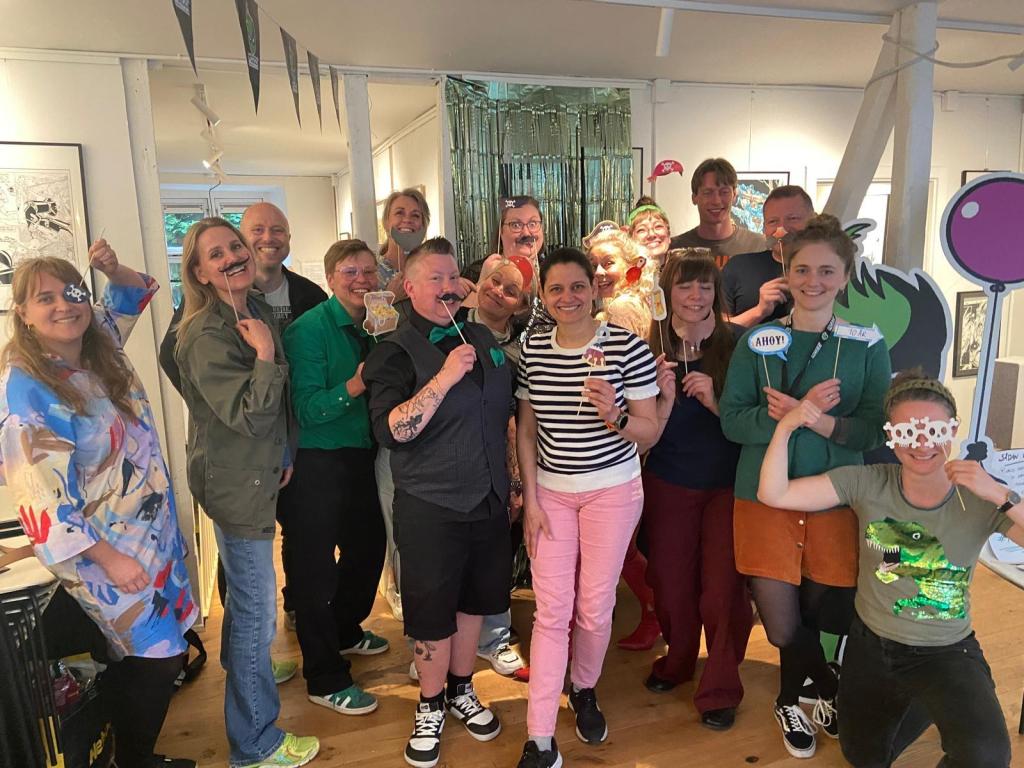
The one I’m most proud of isn’t a single project – it’s the fact that MOZZI just turned 10. We threw a big party, gathered the whole extended crew, and celebrated what we’ve built together.
I’m also proud that we established a Norwegian editorial team in 2025 and have taken on several exciting projects in Norway.
If I had to name a specific project, it would be “Sagaen om Emilie” – a historical romance series we’re handling “The MOZZI Way”, from translation to proofreading and editing. The first two volumes just launched, and a new book is released every three weeks. It’s intense and joyful – and exactly the kind of work we love.
How would you like MOZZI to develop over the next 5 years?
I hope MOZZI continues to grow – not bigger at any cost, but stronger, more sustainable, and with a clearer purpose.
I’d love to start publishing under our own name – books, audiobooks, maybe even games – while continuing close partnerships, particularly in Norway and Sweden.
Mostly, I want to keep building a cozy, kind workplace filled with good people – the kind who work hard and laugh loudly. And I hope we never lose what makes MOZZI special: the closeness, the quality, and the small, nerdy heart at the centre of it all.
What are your thoughts on the future of translation/the creative industries?
We’re in the middle of a major shift – one that can feel both exciting and unsettling. At MOZZI, we try to navigate it with care and a focus on what really matters: quality, audience awareness, and real human connection.
Creative industries aren’t disappearing – they’re simply evolving. Each of us has to decide how we want to be part of that change.
What advice would you give to new translators?
Be curious. Ask questions. There’s so much to learn from editors, proofreaders and fellow translators – and it’s normal not to know everything at first.
Find a sense of community. Talk to people. Even if you’re technically competitors, you’re also colleagues – part of the same creative ecosystem.
And most importantly: don’t take editing personally. Even the best translators get heavily edited sometimes. That’s part of the process, and it can be a gift.
This is a marathon, not a sprint. Go at your own pace. And find the joy in the work.
Thank you so much, Tin. I have very much enjoyed learning more about you and about your fabulous, very human, company. Huge congratulations on your first decade – I hope you celebrate many more!
 Love Languages
Leave a comment