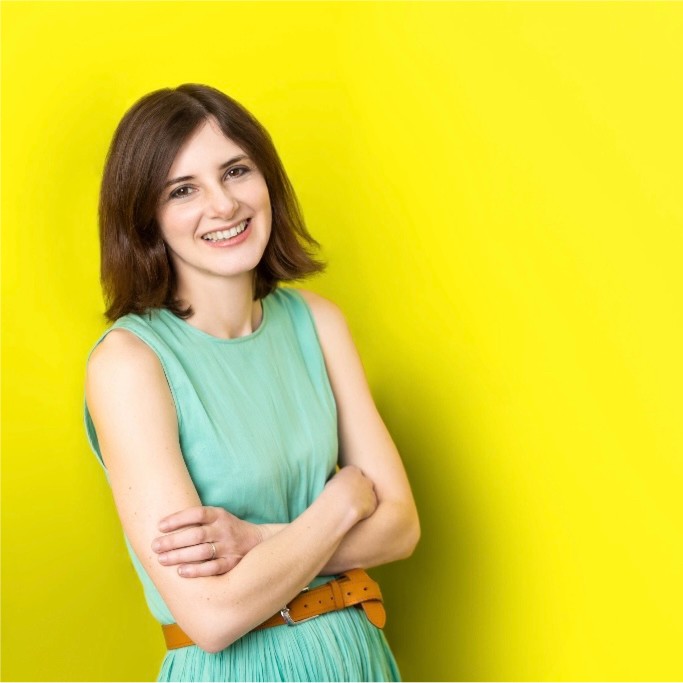
Fuschia, thank you so much for volunteering for MTTM. I understand you are also running a similar project, showcasing different professionals and consultants who work in the sustainability sector, so I would like to direct anyone who might be interested in that to your blog here.
What are your source and target languages, and how did you learn your source languages?
I translate from Italian to English. I fell in love with languages at school but didn’t have many opportunities to learn them beyond French and teaching myself Spanish (with the help of an amazing French teacher who also spoke Spanish!).
I chose to study Italian from scratch at university and spent a happy year in Urbino, Le Marche, for Erasmus and then spent some time doing work experience in Calabria.
When did you first consider becoming a translator, and why?
When I was 13 I stood up in a school assembly and announced that I wanted to be a translator when I grew up.
After uni I did a work experience stint at a famous (and much maligned) translation agency. This opened my eyes to how competitive it was and also how repetitive the work could be – my team managed IT translations. This put me off the profession for a while and I developed a career in multilingual media analysis and then global media auditing. This was a huge benefit as I had experience and insight into global media and advertising, plus the world of work, and I think I would have struggled if I became a translator straight out of university.
I made the move into translation when my eldest daughter was born. It felt like the perfect way to continue to work while having control over my time and availability. This has meant that I built my profile slowly and had to learn to say no to the wrong projects very early on.
Did you undertake formal training to become a translator, and if so, what?
I studied with Translators Training. This prepared me for the Diploma in Translation, which I took and passed in 2017. If you want to work with agencies, then I’d highly recommend a qualification of some kind. Once I’d passed, I started to get more positive responses from translation agencies. However, I don’t think any direct client has ever asked me for my qualifications.
High on my success, I spent a sleepless night writing a blogpost on how to pass the DipTrans here.
There is definitely a knack to DipTrans, isn’t there! I strongly recommend it for those without a translation degree, but I also strongly recommend that they first read your blog post, and then find a specific DipTrans tutor. What services do you offer in addition to translation?
I offer copywriting, transcreation, SEO translation and brand voice development. I also plan to offer messaging development as a formal service soon.
I took a copywriting short course with the CioL shortly after passing my DipTrans and fell in love. I realised that, with my background in media and advertising, there was an opportunity to combine the two skills and offer translation, transcreation and copywriting. There were relatively few people doing this at the time.
I studied a now-defunct year-long course called the Copywriting Apprentice which gave me a strong grounding in copywriting principles and was able to apply them straight away to my translations. SEO, brand voice and messaging skills I’ve built up through workshops, reading and on-the-job experience.
If anyone is curious about adding copywriting to their services, I’d recommend exploring the Procopywriters website.
Which sectors do you primarily work in?
I currently focus on clean beauty and circular consumer products. I’m passionate about living a sustainable lifestyle, volunteer for my local sustainability charity, and through the years have worked with some interesting clients active in sustainability. I also work on sustainability more broadly and have experience in food tech and sustainable manufacturing.
How did you launch your translation career?
I found my first translation client on a freelance site. The pay was shockingly low, but the subject was close to my heart and a revelation that I could work on subjects that I enjoyed.
After that, it was mostly networking. I was lucky to be mentored through the CioL by a successful translator-copywriter in my language pair (you can read about it here). My mentor was kind enough to pass on enquiries he didn’t have time for, and introduced me to other translators. In particular, I’ve got know Italian transcreators and copywriters with similar skillsets. We tend to refer work to each other and also worked on projects together.
I’ve found clients through LinkedIn (both referrals and search), Instagram and my website, which brings in quite a few enquiries.
Since qualifying as a translator, have you undertaken further studies to hone your specialisms and/or languages, or to diversify into other skills, and if so, which?
Since SEO is such an important element of digital marketing, I took a course with the SEO Content Institute. The course is no longer open, but I’ve heard good things about the Translastars courses.
What other CPD do you regularly undertake and recommend?
I always keep an eye on CioL, ITI and Procopywriters courses and take any that complement my skills and areas of interest. I used to do regular language exchanges but fell out of the habit. This is great for getting more confidence if you regularly have calls or online meetings with clients.
Which translation associations or other groups are you a member of? Which are most helpful for offering support, and which (if any) are a good source of work leads?
I’m a member of CiOL and some ITI groups like the London, Italian and Fashion and Beauty groups. Funnily enough, after being a member of CioL for seven years, I just completed my first project via their find-a-linguist directory – a tagline transcreation project for a purpose-led coffee company.
Which translation tools do you use the most?
I use Trados to keep me on track while translating, although, due to the type of work I do, glossaries and translation memories aren’t always super useful. I use Yoast to help me check the optimisation when carrying out an SEO translation.
How do you promote yourself and find clients?
I’ve recently repositioned my services, so this is a work in progress. Previously, I marketed myself as an English translator-copywriter for the Italian market. Now I’m marketing myself as a professional who works with clean beauty and circular product brands and provides copywriting, brand voice development and transcreation.
My current marketing plan is regular LinkedIn updates with content for my target audience, networking in person and online, and working on my website SEO by regularly writing content for my target audience and making tweaks. It’s still a work in progress as the search terms I’m targeting now are more competitive!
If you work with agencies, how do you make a good first impression, and do you send them professional updates to keep yourself relevant to them?
I only work with a handful of agencies now. I found the deadline-driven nature of the work harder when my second daughter was born, as many of the agencies I worked with assumed I was working eight hours a day and weren’t willing to wait much longer than this.
I try to start off on the right foot and develop personal relationships with the project managers, following them on LinkedIn and, if possible having an online call.
What does a normal working day look like for you?
I separate my week by task – on Mondays I deal with admin and prep content. On Tuesdays, if I don’t have client work then I’ll study or connect with colleagues. Wednesday is dedicated to a retainer client in the food tech sector. Thursday and Fridays are spent on any ad-hoc projects and networking.
What is the most satisfying translation project that you have worked on recently?
I recently helped a purpose-led Italian coffee brand with a tagline audit and transcreation. I haven’t yet seen which option they went with, but it was a perfect mix of translation, copywriting, sustainability and creativity.
How would you like your career to progress over the next 5 years?
I want to establish myself firmly in the clean beauty and circular products niche. My aim is to help more companies that are helping turn the tide on consumerism and making sustainable options mainstream.
What are your thoughts on the future of the translation and copywriting industries since the advent of AI?
I’d be lying if I didn’t say that I flip-flop between optimism and desperately googling new AI-proof career paths! I’ve integrated AI into some of my workflows and find it helpful for: reducing word counts, repurposing content (e.g. turning a social media post into a blog post), simplifying text, brainstorming alternative ways to phrase something, summarising customer reviews and analysing tone of voice. As someone who works during school hours, I’m always keen to do certain tasks more efficiently.
However, AI consumes a huge amount of energy and water, so I’m mindful about using it too much, especially given my customer base. Once the hype has died down, I think it’ll become a general part of our work processes, like spell check or CAT tools. In skilled hands, it can be an assistant.
I feel the role of translators and copywriters will become more strategic. While the world only sees the words we write, there is so much work and thought behind them. A lot of our work is strategic: providing cultural consultancy, identifying USPs, adapting texts for different audiences, implementing brand voices. The only challenge is how to communicate this to the rest of the world!
What are your Dos and Don’ts for new translators and copywriters just starting out?
Do: befriend as many colleagues as possible, pass work on to a grateful colleague if it’s not in your wheelhouse, be open and flexible, set (and stick to!) firm boundaries, hone your craft through courses, mentors and feedback, track your time.
Don’t: allow yourself to be bullied into low rates or unreasonable deadlines, work for ‘exposure’ only.
Thank you for the wealth of information you have provided here, Fuschia. It will be a precious resource for anyone hoping to get into translation or copywriting – there are plenty of tips on here that I have made a note of for my own self-improvement!
Fuschia Hutton is a copywriter and transcreator for clean beauty and circular products. You can connect with her on LinkedIn or take a nosy at her website. If you’re interested in joining transcreation meetups online or in person, then get in touch with her to be added to a mailing list to be the first to hear about the next event.
 Love Languages
Leave a comment