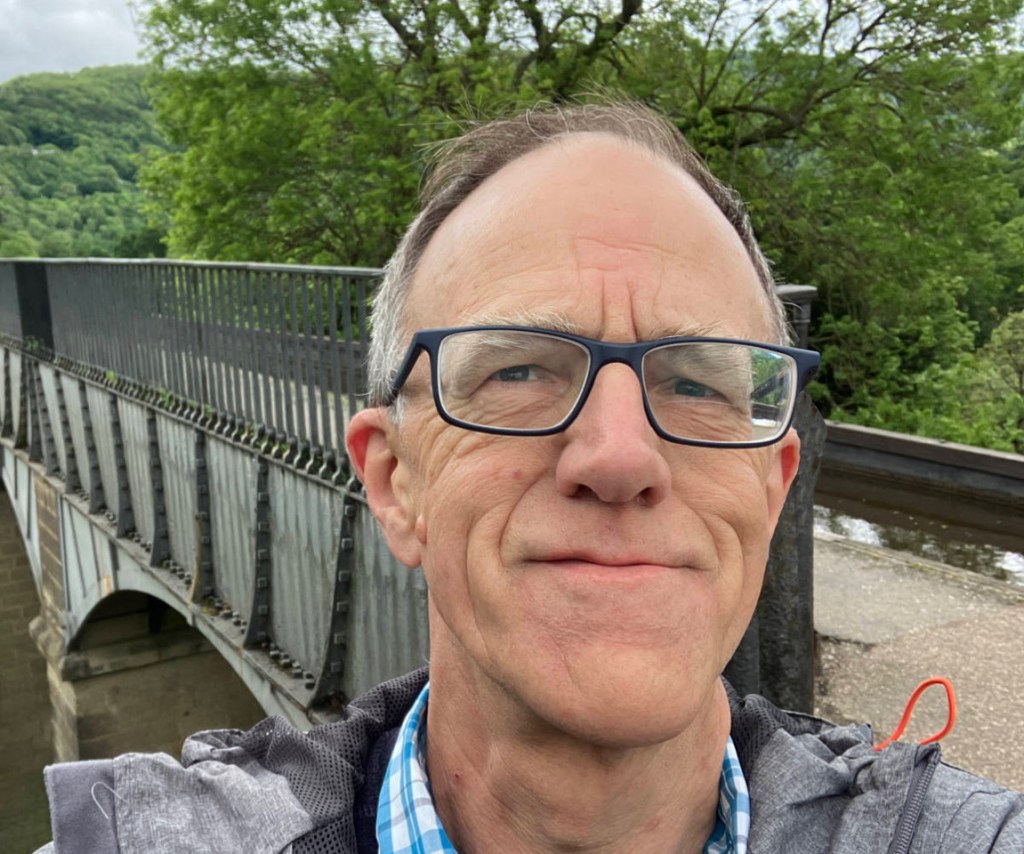
Chris is pictured here practising his unvoiced alveolar lateral fricatives at the Pontcysyllte acqueduct in Wales
This week Chris has kindly volunteered to walk us through his translation career, and out the other side into his current occupation as a multilingual typesetter. Read on to find out more.
Good morning Chris. Could you start by telling us about your language combinations?
I used to translate from French, German and Italian into English, but I’ve refocused on multilingual DTP/typesetting work, and no longer translate.
Being a bit of an ignoramus, I looked up “multilingual typesetting” to find out exactly what it entails. Would you say this article explains it well?
That’s a pretty good outline of multilingual typesetting. The majority of work in a typical job will be getting the text to fit neatly (copyfitting).
Sometimes, people also use the term to cover dealing with hard-to-process PDF files for translation. I prefer to call that multilingual type-un-setting or desktop un-publishing, since you’re taking something intended to be published (the PDF) and picking it apart to obtain clean text content for the translation process. Not my favourite task, but it relies on some of the same box of tricks, notably an understanding of what a PDF can actually be (spoiler alert: it’s just a container for presenting content).
How did you learn your source languages for your translation career?
French and German at school, then added Italian at university. I’ve also picked up a fair bit of “tourist Dutch” from knowing German and via Duolingo and other sources, although I never translated from it. When I speak German, Germans often think I might be Dutch! And the odd word or two of other languages from evening classes here and there, which never seem to go beyond the first term, as people drop out.
What are your specialisms, and why?
When I was translating, I tried to specialise in the industry areas that I had some experience with from previous jobs.
With the typesetting, I kind of fell into it via database publishing, at a company which produced manuals from a big multilingual database of vehicle lubrication information. That skill helped out at my later job in a translation agency, where I got to grips with typesetting all kinds of non-Latin scripts.
How did you decide on your careers?
Well I came out of university wanting to do something with my languages, and my first job was as a nearly-translator, producing abstracts from the world’s business press. Some of that work was from non-English sources such as Farbe + Lack, the highly interesting journal of the German paint and coatings industry. Things moved on, and to cut a long story short, a benevolent boss paid for evening classes in whatever we wanted to do – I did some Russian for one term (then the class folded due to lack of interest), but that rekindled my love of language, leading to a change of job to become a project manager in a translation agency. There, I discovered I was “wearing too many hats”, so I decided to go freelance with translating and typesetting. That was in my forties. I’ve since concentrated on the typesetting.
Can you talk us through the courses and qualifications you have taken over the years, and which have been most beneficial for your translation career?
Most of what I’ve learnt has been self-taught, or taught by work colleagues, so I can’t really recommend anything here. My computer/tech knowledge has been driven by constructive laziness: “there must be an easier way to do this”.
How do you find clients?
These days, new clients tend to be via contacts (some of them from years back) and recommendations/word of mouth. Earlier in my freelance career, it was from applying to agencies. and companies that I’d previously worked for.
Which groups or organisations are you a member of, and which do you find most beneficial?
I joined the Chartered Institute of Linguists when I went freelance, as much as a statement of professional intent as anything else. I’ve been a member of the Yorkshire Translators & Interpreters for most of that time (also on their committee for a good few years), and I’m a more recent affiliate member of the Institute of Translation & Interpreting. Of those three, I get the most out of the local YTI group, in particular on the social side of things, which is important for a profession where many people work from home without the face-to-face contact of an office job.
How would you like your career to develop over the next five years?
Retire! But very gradually, so that I’m still doing the interesting stuff. One can dream.
Do you have any Dos or Don’t for new translators?
I’ve grouped these into the general and the specific…
Generally:
1/ Don’t panic if you don’t go straight into a pure translation job: experience from other work may in fact make you a better translator in the long run.
2/ Do remember you have a lot of transferable skills: you can probably write in your target language better than most, you probably have a better eye for details than most people, and you’re probably pretty good at understanding other people’s points of view (after all, that’s a key requirement to making a good translation).
3/ Do network: even if you don’t see any immediate benefit, things can come back literally years later “I know someone who does that”.
Specifically:
4/ Do ask for the source before blindly saying yes: and do say no if it turns out to be completely out of your comfort zone. There’s a difference between “I don’t know that, but I can research it” and “How hard can it be?”.
5/ Don’t be afraid to ask questions: but do save them up and ask in one go, to save your project manager bothering their client repeatedly.
6/ Do ask for the pictures: translation texts are often accompanied by graphics of one sort or another, and the visual context can make the difference between a poor translation and a good one. I often see such problems when I’m typesetting someone else’s translation, where they’ve not seen a picture which would have changed the translation.
What have you been working on recently?
Typesetting the translated versions of a booklet about coping with the cost of living, in Arabic, Somali, Romanian and Chinese.
Preparing to give an online talk to the University of the Third Age “How Many Letters in the Alphabet? A tour of the world in writing systems”.
The talk sounds fascinating. Will you be recording it to post on LinkedIn? Please let me know if you do!
Referring back to the article on Multilingual typesetting, it suggests that familiarity with the languages you are working on is important, does that mean that you also speak such varied languages as Arabic, Somali, Romanian and Chinese?
I have a good working knowledge of how the writing systems of the various languages work, both linguistically and technically (including the quirks and foibles of language support in various bits of software). I also know the assorted rules and conventions for typesetting those languages, such as the single-letter prepositions in Slavic languages mentioned in that article (non-breaking spaces to the rescue in that case). But I wouldn’t be able to hold a conversation in most of them!
Chris, thank you very much, this has been fascinating. You have brought two “firsts” to MTTM this week: first male volunteer and first volunteer who has moved through translation and into another equally fascinating career!
If anybody would like to showcase their talents on MTTM next week, please feel free to contact me.
 Love Languages
Leave a comment