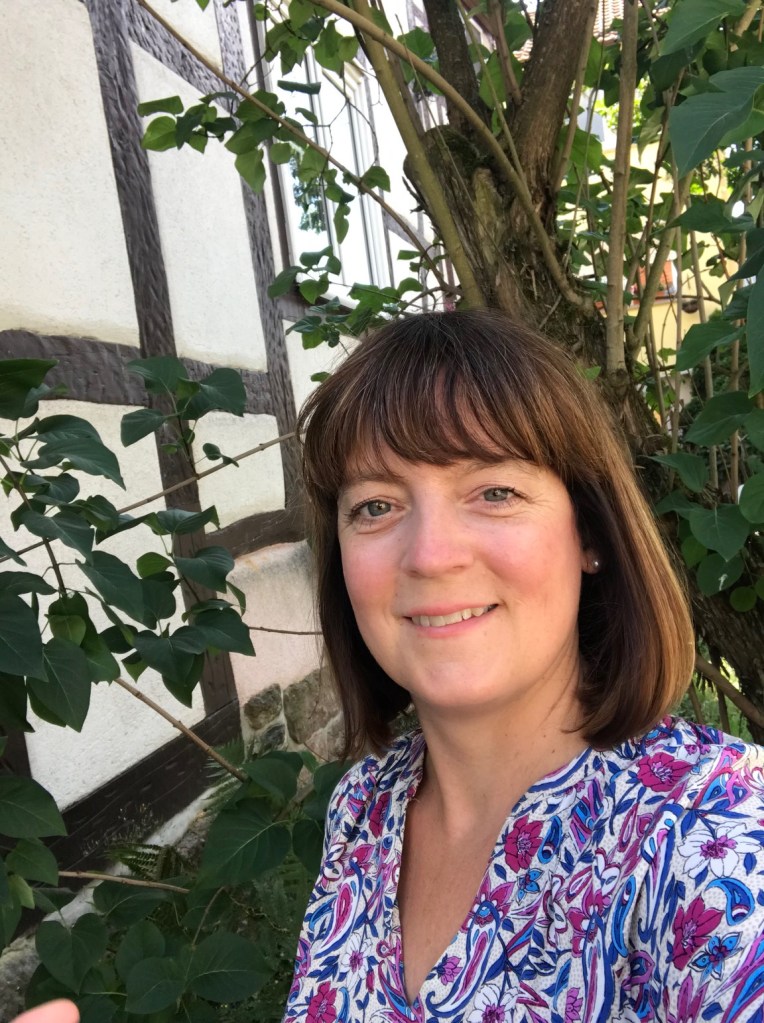
Iris Heldensen
English and Italian to German translator.
Marketing, transcreation and certified translations.
Based in Hesse, Germany.
Hello Iris! You are my first non-British interviewee, which is very exciting! Thank you so much for wanting to get involved in Meet the Translator Monday. Could you start by telling us about your language combinations?
I mainly work from English into German, occasionally from Italian into German as well. For some clients and for certified translations, I also work from German into English, usually in collaboration with a couple of DE>EN colleagues.
How did you learn your source languages?
I started learning English at school from the age of 10. I also chose English as my main subject during my “Abitur” (A-levels), although I didn’t actually do particularly well. Spending a year in London as an Au pair was the game changer for me – I developed a deep love for the language and the culture.
As far as Italian is concerned, I only started studying the language at university as part of my translation degree. I spent a term in Italy (Gorizia) which again was some kind of “breakthrough” in mastering the language!
I completely empathise with your experience of learning languages at school as opposed to “in the real world”. I definitely thrive far more when surrounded by a language and its culture. What are your specialisms, and why?
I specialise in marketing translations and transcreation, as well as certified translations. The marketing specialism came to me quite naturally, given my previous career, expertise and network.
When did you decide to become a translator, and why?
I studied translation simply because I wanted to “do something with languages”.
After graduating from university, I really didn’t want to work as a translator. This was in 2000 – the translation world was very different then… no CAT tools, limited online research possibilities … It just felt very boring to me at the time. I started looking for any job that required language skills and sort of fit my profile and ended up working for the advertising agency Saatchi & Saatchi in Frankfurt – first as a team assistant, then in the international coordination department for Audi, organising the adaptation of international TV and print ads for countries all over the world. Through a colleague I heard about a job opportunity in London and went on to work for the advertising agency DDB – again, coordinating, managing and developing campaigns and advertising on an international piece of business. I stayed there for almost ten years – until my first daughter was born and the fast-paced advertising industry was no longer a good fit to my personal circumstances.
I moved back to Germany, briefly taught English at school (hated it), and then decided to leverage my existing network and start off as a freelance translator. That was 14 years ago, and I have never looked back!
Can you talk us through the courses and qualifications you have taken over the years, and which have been most beneficial for your translation career?
Naturally, the strong foundation of my business is my translation degree (University of Mainz, Department of Applied Linguistic Studies in Germersheim). Whilst the linguistic training was absolutely fantastic, we didn’t learn much about the entrepreneurial side of things. Luckily I had my advertising career that was really helpful in that respect.
In more recent years I have taken courses on editorial SEO, gender-neutral language, AI and MTPE. Generally, I find it important to always gain at least a basic understanding of the new developments on the market. MTPE is not really a part of my service portfolio, but I still need to understand what it’s all about and where the pitfalls are – so I did some training anyway.
What CPD activities do you undertake?
I regularly attend relevant workshops or seminars. I also read the BDÜ member magazine or other similar publications.
And there is of course networking – I love networking. Whether it’s online through LinkedIn or in real life. There is so much to learn and share when you’re with colleagues.
How do you market yourself?
I don’t do a lot of marketing, to be honest. My main focus is on LinkedIn and general networking which comes very natural to me, but I don’t have an actual “plan”.
At this stage of my freelance career, my main marketing tool is the quality of my work itself. Almost all of my new clients find me through recommendations.
For certified translations I have a Google Business Profile, as private individuals tend to search for a translator in their area. It works really well.
And after more than ten years with a terrible self-made website, I finally set up a proper one a couple of years ago. It’s an essential part of how I present myself as a freelancer, but it is not an acquisition tool.
Which groups or organisations are you a member of, and which do you find most beneficial?
I am a member of the BDÜ – the German Association for Interpreters and Translators. They offer great CPD opportunities, as well as support with professional insurance, legal advice etc. I’ve also been contacted by clients a few times as a result of being listed in the directory.
I’ve also been thinking about joining the ITI as they seem to do lots of interesting things. So far, however, I haven’t looked into that properly.
How would you like your career to develop over the next five years?
Given the market developments and my personal circumstances, I will be very happy if things simply continue the way they are. I still dream of writing a book, but I am afraid this will have to wait until my children require less attention…
Do you have any Dos or Don’t for new translators?
I strongly recommend gaining non-translation work experience in your area of specialism. Or simply just general work experience working in any team – doing anything really. You might be an expert linguist, but there is so much more to it. You need to understand how to communicate with clients, how to work in a team, how to do business … And to do this effectively, you need to understand the world of your clients and their processes!
What are your impressions of the industry as it is today?
Turbulent times. Many very good colleagues are giving up freelancer life for employment, often also in completely different areas.
On the other hand, I know many stories of clients falling flat on their faces using AI. They’ve all come back and now appreciate the work we do even more.
Do you have a message of hope for translators trying to break into the industry?
It’s a very tough time to start out. My advice would be to make sure you have a solid network and (as terrible as this may sound) to have a back-up plan.
It might be a naïve perspective, but I wonder if the AI trend in translation is comparable to ready-made meals and the like. When convenience food first came onto the market, it was incredibly popular. But after a while people began to realise how unhealthy ready-made meals are. And while such food still exists, of course, there was and is a whole movement of people focussing on organic choices, clean eating, health nutrition… This is only my personal observation and view – but maybe it is indeed a message of hope to hold on to.
Can you tell me about one of your favourite projects you’ve worked on to date?
This is really tricky – I’ve worked on so many, it’s impossible to pick one! I do a lot of beauty and fragrance press releases. I love them all for their often flowery language and the freedom I have in adapting them.
Recently I’ve had a few interpreting assignments at our local registry office. Helping two people tie the knot is definitely a wonderful project (plus the added benefit that you have an excuse to dress up and leave the house for work 😊).
How do you deal with the – inevitable – lulls?
Over the years I have learnt that every single lull is followed by my inbox being inundated with requests. Nonetheless, lulls can still be very daunting. I try and use the time to catch up with admin or simply enjoy the free time.
Every month, however, I put money aside into my “business reserve fund”. With this, my business can survive a lull period and is still able to cover all the bills (and my income). This is a must for any freelancer or business owner, and I am often surprised that many colleagues don’t have that. On top of financial stability, it provides a lot of peace of mind in these quiet periods!
Iris can be found on LinkedIn here and via her website here.
Thank you so much for sharing your thoughts and your experience with us, Iris. I look forward to reading that book once you have the time to write it.
 Love Languages
Leave a comment